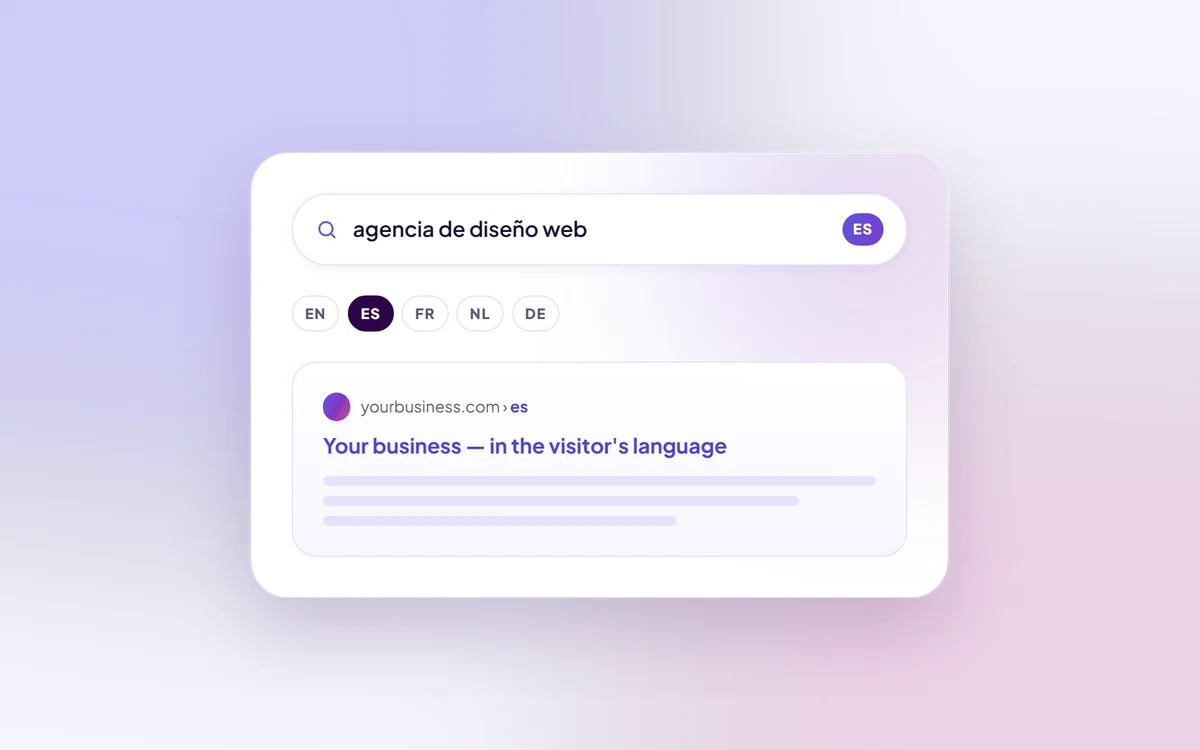
Multilingual SEO: how to be found in more than one country
Translating your website is only the first step. Here is what search engines need to show the right language version to the right people.
Read article
Multilingual websites
We build websites with real language versions: each with its own address, its own search terms and texts checked by a native speaker, including Arabic written right to left. So every visitor finds you, understands you and contacts you.
Building for businesses since 2016 — trusted by hundreds of clients.
01 — Why it matters
In a study of 8,709 consumers in 29 countries, CSA Research found that 76% of online shoppers prefer to buy when the information is in their own language, and 40% never buy from websites in another language. The same applies to search: people type their question in their own language, so a page that only exists in English is invisible to them.
Translated words are not enough: each language version has to be found, trusted and used.
A multilingual website is more than a translation plugin. Each language needs its own pages that search engines can index, its own search terms (people in Germany search differently from people in Austria), and texts that sound natural. For Arabic, the whole layout is mirrored from right to left, with fonts and numbers that read correctly.
02 — What's included
Clear folders such as /de/ and /ar/, each version indexable on its own, as Google recommends.
We research how people search in each market and write titles and pages around those terms.
You supply the texts or we arrange the translation; either way a native speaker checks them before launch.
A fully mirrored layout with Arabic fonts, correct numbers and Latin words that stay readable.
Visitors see their language suggested and can always switch, while search engines reach every version.
For online stores: prices, payment methods, VAT and shipping set up per country.
Learn more03 — Done right technically
We follow Google’s guidelines for multilingual sites: one address per language, hreflang links between the versions and no forced redirects that hide versions from visitors or search engines.
04 — Process
We learn about your business, your customers and your goals, and agree on what the website must achieve.
We map out the pages and the path visitors take, then design the look. You give feedback until it feels right.
We build the website, add the content and test it on every screen size and in every language version.
We put the site live, set up search engines and stay available for updates, SEO and new features.
05 — FAQ
For most businesses, subfolders such as /de/ and /ar/ on one domain: they share the domain's authority, are easy to maintain and are clear to Google. Separate country domains only make sense if you run separate businesses per country.
Machine translation is a good starting point, but unchecked it produces wording customers notice, and it never chooses the terms people actually search for. We combine it with keyword research and a native speaker's review.
Only gently. Google advises against forced redirects, because they can hide versions from visitors and search engines. We suggest the right language, keep a clear language switch on every page and never block a version.
No. A page should exist in the languages of the people it is for. A page about Saudi e-invoicing belongs in Arabic and English, not in Dutch. We plan the languages per page instead of translating everything.
It depends on the number of languages and pages, who supplies the texts and whether there is a shop. Our website cost guide shows what published price guides say; your own quote is free and personal.
06 — Guides
Translating your website is only the first step. Here is what search engines need to show the right language version to the right people.
Read article
The honest answer is: it depends. Here is what published price guides say, what drives the price, which running costs to plan for and how to compare quotes.
Read article
Many agencies look alike online. The real differences show up in the answers to a few direct questions. Here are ten to ask, the red flags and how to compare quotes fairly.
Read articleTell us where your business stands today and what you want to achieve. Together we'll work out which website, app, AI solution, brand or marketing approach fits you best.
Prefer a direct line? Email, call or WhatsApp us: