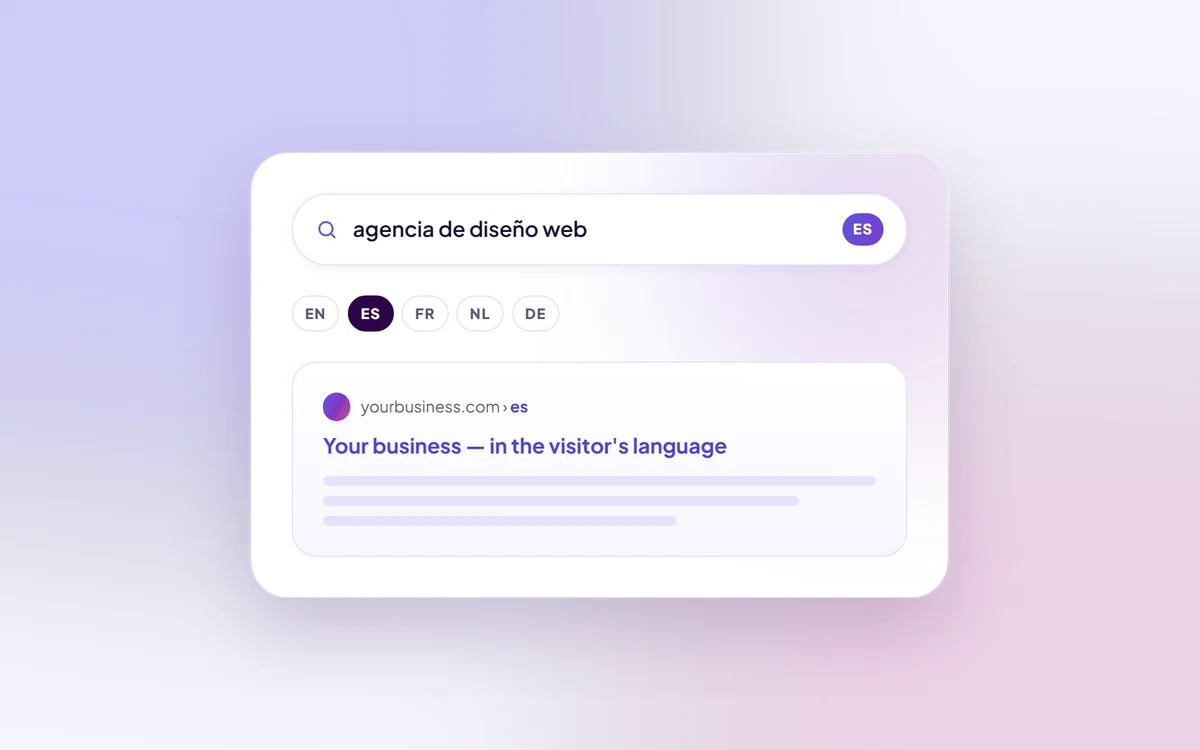
When you sell to customers in different countries, a website in one language leaves many of them behind. People search in their own language, and search engines try to show results in that language. Multilingual SEO makes sure each language version of your website can be found — and that every visitor lands on the version that suits them.
1. Give every language its own URL
Each language version needs its own address, for example example.com/es/ for Spanish and example.com/de/ for German. Avoid showing different languages on the same URL based on a cookie or a script: search engines usually see only one version, and the others stay invisible.
2. Translate the URLs too
A Spanish page about web design works better as /es/diseno-web/ than as /es/web-design/. Translated URLs match what people type, look trustworthy in search results and make every link self-explanatory.
3. Tell search engines how the versions belong together
Hreflang tags tell search engines that /web-design/ and /es/diseno-web/ are the same page in different languages. Each version lists all the others, including itself, and an x-default points to the version for everyone else. Add the same information to your XML sitemap.
4. Translate for people, not word for word
Keyword research has to be done for each language. People in different countries use different words for the same thing, and a literal translation often misses the term people actually search for. Have native speakers review the texts — page titles and meta descriptions included.
5. Localise the details
- Use local formats for dates, numbers, currencies and phone numbers.
- Show examples, references and contact options that make sense in that market.
- Translate image alt texts, buttons, forms and error messages — not only the body text.
6. Don't lock visitors into one language
Sending visitors to their language version automatically can help, as long as it happens only on the homepage, only once, and never for search engines. Always offer a clear language switcher, and remember the choice a visitor makes.
7. Measure each language separately
Set up Google Search Console and look at each language version on its own: which pages appear, for which searches and in which countries. That shows where the next improvement will have the biggest effect.
Planning a site in several languages? See how we build multilingual websites with a proper structure for every language, and how our SEO service researches keywords market by market.
Planning a website in several languages? We build multilingual websites with translated URLs, hreflang and language sitemaps from the start — this website is an example.
Free quote